David Newsome's family video DVD
The Life ListDavid Newsome’s family video DVD transforms preserved footage into evidence of a family history Brett Bohlinger could not otherwise see. At a gathering with Carrie Newsome and Stella Myers, the recordings first show Brett’s mother, Elizabeth Bohlinger, pregnant with her, and then lead Brett to footage of Johnny Manns performing at Justine’s. The discs do more than recall the past: they give Brett a visible and audible basis for recognizing her father.
From VHS to a Shared Family Record
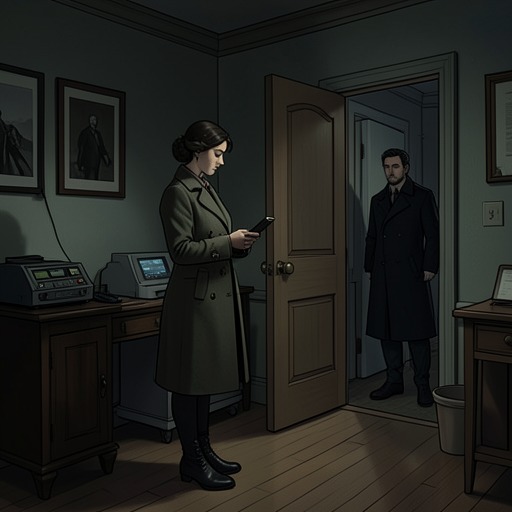
The footage emerges after the crowd has left and Brett, Carrie, Stella, and Mary Newsome are putting away leftover food. David calls them into his den, where Carrie’s children gather around the television expecting a Disney DVD. Instead, Brett and Carrie watch two tapes of their younger selves, laughing at the children they once were. The family-video collection begins as a source of shared amusement, placing Brett’s childhood within the Newsomes’ own remembered past.
David explains that converting his old VHS films to DVD took about six months. The detail gives the collection a history of its own: the images had to be transferred from one format to another before they could be replayed on the den’s television. David searches through shelves lined with DVDs, selects a disc he says Brett will not remember, and presses play. The recorded scenes are thus not simply recollections told by the people in the room. The images themselves become available for renewed viewing, carrying details that their viewers may not have known or retained.
Elizabeth on the Screen
The selected footage shows a young Elizabeth with a Farrah Fawcett haircut, wearing a navy maxi coat that cannot button over her pregnant belly as she pulls two towheaded boys on a sled. Brett leaps from the sofa and kneels in front of the television, covering her mouth. She identifies the woman as her mother and realizes that Elizabeth is pregnant with her. A familiar family image becomes something newly intimate: the screen shows Brett not as the adult searching for answers, but as an unseen child already present in her mother’s life.
Brett’s response moves from shock to tenderness and grief. She accepts a box of Kleenex from Carrie and calls Elizabeth beautiful, then notices that sadness is etched into her face. The footage makes Elizabeth’s appearance available for close attention, but it cannot explain the sorrow Brett sees there. That limit matters: the DVD supplies an image, not a complete account of the life behind it. Its evidence is powerful precisely because it opens a question as well as answering one.
David says he filmed the scene when the group lived on Bosworth Avenue. Brett corrects him, thinking of Arthur Street, and David clarifies that the families had been friends from much earlier; the Newsomes were Elizabeth’s first customers. The exchange gives the footage a specific place in the families’ shared history and establishes that David knew Elizabeth before the later gathering. When Brett asks whether Mary remembers Johnny, Mary recognizes him as the guitarist who played at Justine’s. The old recording has now prompted a search for a person tied to Elizabeth’s earlier life.
Johnny Manns Recorded at Justine’s
David finds another case in his DVD collection. He had filmed Johnny at Justine’s while tending bar, and recalls that those who saw him perform believed he was destined for success. On the screen, a small, dimly lit bar is crowded with young people. The camera settles on a man with shaggy black hair and a full beard and mustache. As it zooms in, his brown eyes meet the viewer’s. Brett recognizes them as the eyes she sees in the mirror, and the resemblance makes the recording personal before anyone has to explain it.
Johnny introduces a song from the Beatles’ White Album and sings about a blackbird longing to fly and be free. The performance gives the disc a voice as well as a face. Brett thinks of Elizabeth, imagining her as a mother with two young children and a husband she did not love, and connects the song’s longing for freedom with what her mother might have wanted. She also hears in its waiting a shape for her own long-delayed hope of looking at her father and recognizing him. These are Brett’s reflections, not facts established by the recording; the performance provides the occasion for her to bring separate family histories into relation.
After the song ends, the disc cuts to another scene at Justine’s featuring a female singer. Brett does not ask David to rewind it: she simply does so herself, watching the performance again and again. She reaches toward Johnny’s face and hands on the screen and listens to his voice. The footage cannot return a living encounter, but replay makes its brief images and sounds available to her repeatedly. She watches four times before falling silent, while Mary sits beside her on the floor and David sits at her other side.
The Disc Becomes Brett’s
David places the DVD in Brett’s lap and asks, “This belongs to you, doesn’t it?” Brett traces a finger over the disc, nods, and answers, “He was my father.” The exchange changes the object’s immediate meaning. It had been one item among David’s archived recordings; in Brett’s hands, it becomes a personal record of a man she recognizes as her biological father and of a performance that makes that recognition tangible.
The timing sharpens the contrast between the discs. The first recording reveals Brett before birth, visible only through Elizabeth’s pregnancy; the Justine’s footage reveals Johnny through his adult face, eyes, and singing voice. Neither video narrates the intervening family history, and neither can supply every answer Brett wants. Together, however, they offer distinct kinds of evidence: one places Brett inside her mother’s past, while the other gives her a likeness and voice through which to identify her father.
The family video’s significance therefore rests not only on what it preserves, but on what happens when its images are watched. David’s careful conversion and keeping of the recordings make this recognition possible; Brett’s repeated viewing turns access into attention, and attention into a claim on the disc. His gift gives her a physical object to carry away from the den, linking private recognition to the family archive that made it possible. The DVD becomes a bridge between people who knew Johnny, the past David recorded, and Brett’s newly understood place in that past.